Panel upgrade vs. load management for growing household power needs
When your home needs more power than it was built for
Over the past decade, the average household has quietly added more electrical load than most existing panels were designed to handle. Electric vehicle chargers, heat pumps, induction cooktops, home offices with multiple monitors, and larger entertainment systems all draw current that older service ratings were never meant to supply. Homeowners often notice the problem indirectly: a breaker that trips when the oven and the dryer run at the same time, lights that dim when the air conditioner kicks on, or a main breaker that occasionally lets go. These are signs that the demand load has crept past the capacity of the existing service entrance.
Two broad paths exist for solving this mismatch. One is a residential panel replacement that raises the amperage and brings the whole system up to modern code. The other is load management: devices and strategies that keep the existing panel by staggering or shedding loads so that peak demand stays under the main breaker rating. Each approach has its own cost profile, timeline, and suitability depending on the home and the household's habits.
Residential panel replacement: what it involves
A residential panel replacement means removing the existing service panel and installing a new one with a higher service rating, typically 200 amps where an older home might have a 100 or 125 amp main breaker. The work includes upgrading the electrical meter socket if needed, replacing the main breaker, and often running new feeder cables from the utility point of connection. In some cases the service entrance conduit must also be enlarged to accommodate heavier conductors.
The primary advantage of a full panel upgrade is that it permanently removes the capacity ceiling. Once the panel is rated for higher amperage, the homeowner can add circuits for a car charger, a heat pump, or additional appliance circuits without worrying about tripping the main breaker. The panel also gets modern safety features: arc-fault breakers, tamper-resistant receptacles, and better coordination between branch circuits. For a household that expects to keep adding load over the next decade, this is the cleanest solution.
On the other hand, a panel replacement is a significant electrical project. It requires a permit, a utility coordination for the meter, and a period without power while the changeover happens. The cost reflects the materials, the labor, and any necessary structural modifications around the panel location. It also assumes the existing wiring within the home is in good enough condition to handle the new capacity; if the branch circuits themselves are undersized or deteriorating, those may need attention as well.
Load management: working within the existing panel
Load management takes a different approach. Instead of increasing the supply, it controls the demand so that the total draw never exceeds the panel's rating. This can be done with a smart load-shedding device installed at the panel, with individual circuit timers, or with a sub-panel that prioritizes essential loads and sheds non-essential ones when total current approaches the main breaker limit.
For example, an electric vehicle charger can be wired through a load management controller that monitors the home's total current. When the oven and the dryer are both running, the charger automatically reduces its output or pauses until the other loads drop off. Similar devices exist for heat pumps, electric water heaters, and pool pumps. The household never loses power, and the panel never sees a spike above its rating.
Load management is often much less invasive than a panel replacement. There is no need to coordinate with the utility for a meter upgrade, no interruption of service during the installation, and typically no structural work. The devices themselves are relatively compact and can be added to the existing panel or mounted nearby. For homes where the load growth is modest or concentrated in one or two high-power devices, load management can be a very practical solution.
The trade-off is that load management does not increase the total capacity. If the household later adds more high-load appliances, the system may reach its limit again. The homeowner also depends on the management device operating correctly; a failure could mean a tripped main breaker until the device is repaired. And some people find the idea of an appliance pausing during peak times inconvenient, especially if they are not expecting it.
When each approach fits best
The choice between panel replacement and load management depends on a few key factors. The first is the size of the gap between current demand and panel capacity. If the existing panel is already close to its limit and the household plans to add multiple large loads, a panel upgrade is usually the more straightforward long-term answer. If the gap is small and the only future addition is, say, a single EV charger, load management may cover it.
The second factor is the age and condition of the existing panel. A panel that is 30 or 40 years old may have corrosion, loose connections, or a main breaker that is no longer reliable. In that case, a residential panel replacement addresses both the capacity issue and the safety issue at once. Replacing an old panel also brings the system up to current code, which can matter for insurance and resale.
Third is the physical space around the panel. In some homes, the panel is in a tight basement or a finished wall cavity that limits how large a new panel can be. Load management devices often fit into the same footprint or can be mounted remotely, which may be the only practical option without extensive construction.
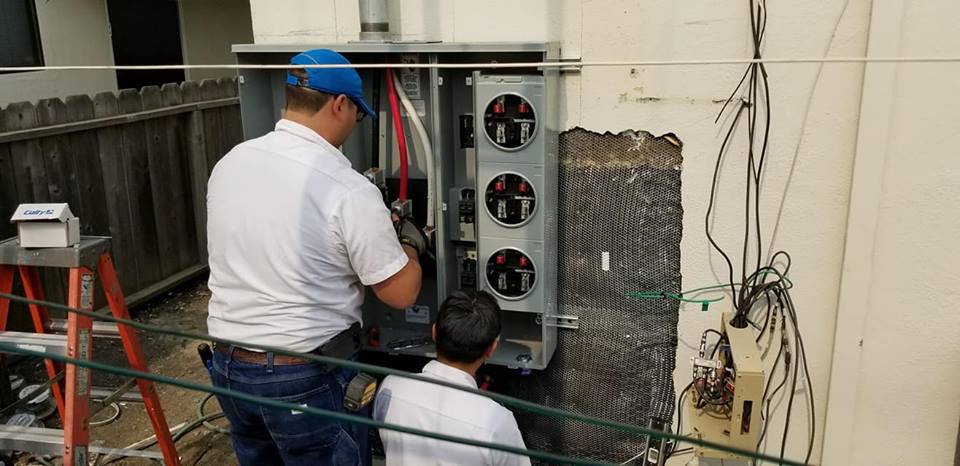
Fourth is the household's tolerance for inconvenience during the work. A panel replacement means a full-day power outage and some disruption. Load management devices can often be installed with minimal downtime, sometimes in a couple of hours.
Wooding Electric evaluates, replaces, and upgrades electrical panels for homes and properties in San Jose and nearby Bay Area communities. Their team can help a homeowner assess whether a full panel replacement is warranted or whether a load management strategy would suffice for the specific loads in the house.
Common questions homeowners ask
Many homeowners wonder whether they can simply add a larger main breaker to the existing panel. In most cases, this is not allowed by code because the panel bus bars and the feeder cables are sized to match the original rating. Installing a higher-rated breaker without upgrading the conductors creates a fire hazard. A panel replacement, or at least a service entrance upgrade, is the proper way to increase amperage.
Another question is whether load management devices are reliable. Modern devices from established manufacturers have a good track record, but like any electronic component, they can fail. The system should be designed so that a device failure results in a tripped breaker rather than an overloaded circuit. A qualified electrician can verify that the fail-safe logic is correct.
Some households want to know if they can combine both approaches. For example, a homeowner might install a load management device for an EV charger now, then plan a full panel replacement a few years later when the budget allows or when other major loads are added. That is a sensible phased strategy, as long as the load management device can be relocated or reused in the new panel.
Finally, people often ask how to tell if their panel is near its limit. A licensed electrician can perform a load calculation based on the installed appliances and their usage patterns. The calculation gives the total demand load, which can be compared to the panel's service rating. If the demand load regularly exceeds 80% of the panel rating, the system is working hard and may benefit from either load management or an upgrade.
Making the decision
There is no single right answer for every home. A panel replacement gives the most headroom and the fewest restrictions on future additions. Load management offers a faster, less disruptive fix for a specific load that pushes the system to its edge. Many homeowners start with load management and later decide on a full upgrade when they remodel or add a major appliance. The key is to have a clear picture of the current load, the planned additions, and the condition of the existing equipment.
Wooding Electric can evaluate the existing panel, discuss the household's usage patterns, and explain the options without pressure. Understanding the trade-offs allows a homeowner to choose the path that matches both their budget and their long-term needs.